Understanding the spiritual significance, history, and practice of the Festival of Sacrifice in Islam.
Eid ul-Adha, known as the “Festival of Sacrifice,” is one of the two major Islamic celebrations observed by Muslims worldwide. It falls on the 10th of Dhul Hijjah, the twelfth and final month of the Islamic lunar calendar, and coincides with the completion of the Hajj pilgrimage in Makkah.
This blessed occasion commemorates the ultimate act of devotion demonstrated by Prophet Ibrahim (Abraham) عليه السلام, who was willing to sacrifice his beloved son Ismail (Ishmael) عليه السلام in obedience to Allah’s command. When Allah saw Ibrahim’s unwavering faith, He replaced Ismail with a ram, and both father and son passed this great test.
فَلَمَّا بَلَغَ مَعَهُ ٱلسَّعْىَ قَالَ يَـٰبُنَىَّ إِنِّىٓ أَرَىٰ فِى ٱلْمَنَامِ أَنِّىٓ أَذْبَحُكَ فَٱنظُرْ مَاذَا تَرَىٰ ۚ قَالَ يَـٰٓأَبَتِ ٱفْعَلْ مَا تُؤْمَرُ ۖ سَتَجِدُنِىٓ إِن شَآءَ ٱللَّهُ مِنَ ٱلصَّـٰبِرِينَ
“And when he reached with him [the age of] exertion, he said, ‘O my son, indeed I have seen in a dream that I [must] sacrifice you, so see what you think.’ He said, ‘O my father, do as you are commanded. You will find me, if Allah wills, of the steadfast.’”
— Surah As-Saffat (37:102)
Qurbani (also known as Udhiyah in Arabic) is the act of sacrificing an animal — typically a sheep, goat, cow, or camel — during Eid ul-Adha as an act of worship and obedience to Allah. It is performed after the Eid prayer on the 10th of Dhul Hijjah and can be carried out until sunset on the 12th of Dhul Hijjah.
فَصَلِّ لِرَبِّكَ وَٱنْحَرْ
“So pray to your Lord and sacrifice [to Him alone].”
— Surah Al-Kawthar (108:2)
The majority of scholars consider Qurbani to be Wajib (obligatory) for every sane Muslim who has reached the age of maturity and possesses the Nisab (minimum threshold of wealth). This is based on the practice of the Prophet Muhammad ﷺ, who never abandoned this act of worship.
“Whoever can afford to offer a sacrifice but does not do so, let him not approach our place of prayer.”
— Prophet Muhammad ﷺ (Sunan Ibn Majah 3123, graded Hasan)
The act of Qurbani carries immense spiritual reward. It is a means of drawing closer to Allah, expressing gratitude for His blessings, and caring for the less fortunate in our communities.
“There is nothing dearer to Allah during the days of Qurbani than the sacrificing of animals. The sacrificed animal shall come on the Day of Judgement with its horns, hair and hooves. The sacrifice is accepted by Allah before the blood reaches the ground. Therefore sacrifice with an open and happy heart.”
— Prophet Muhammad ﷺ (Sunan al-Tirmidhi 1493)
لَن يَنَالَ ٱللَّهَ لُحُومُهَا وَلَا دِمَآؤُهَا وَلَـٰكِن يَنَالُهُ ٱلتَّقْوَىٰ مِنكُمْ
“Their meat will not reach Allah, nor will their blood, but what reaches Him is piety from you.”
— Surah Al-Hajj (22:37)
This beautiful verse reminds us that the essence of Qurbani is not the physical act itself, but the sincerity, devotion, and Taqwa (God-consciousness) behind it.
Islamic tradition teaches us that the meat from Qurbani should be divided into three equal portions:
Keep one-third for your household to enjoy and celebrate Eid together.
Gift one-third to neighbours, friends, and relatives to strengthen bonds of kinship.
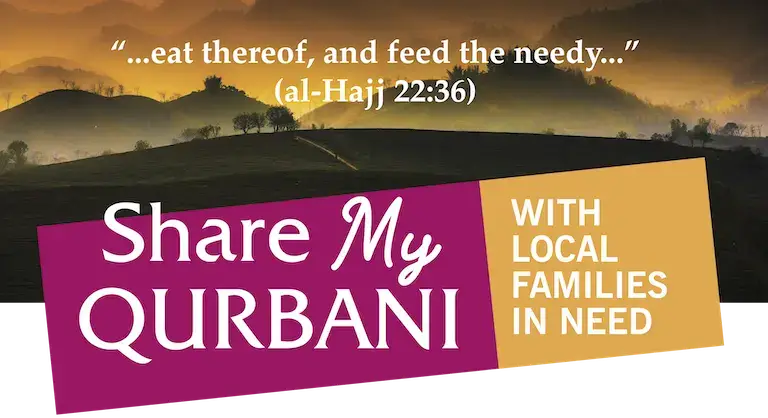
Donate one-third to those less fortunate — this is where ShareMyQurbani helps.
“Eat from it, feed others, and store some.”
— Prophet Muhammad ﷺ (Sahih Muslim 1971)
In the UK, many families struggle to afford meat, and the blessing of fresh Qurbani can make an enormous difference. By donating your third portion through a Qurbani Bank, you ensure that no family in your local community is left out of the Eid celebration.
Qurbani must be performed after the Eid prayer on the 10th of Dhul Hijjah and can continue until sunset on the 12th of Dhul Hijjah (3 days).
Sheep and goats (at least 1 year old), cattle (at least 2 years old), and camels (at least 5 years old). The animal must be healthy and free from defects.
Every sane, adult Muslim who possesses wealth equal to or exceeding the Nisab threshold. One sheep/goat counts for one person; a cow/camel can be shared by up to seven people.
It is Sunnah not to cut hair or nails from the 1st of Dhul Hijjah until after the sacrifice. The animal should be slaughtered in the name of Allah (Bismillah, Allahu Akbar).
The sacrifice must be performed solely for the sake of Allah. It is an act of worship, not merely a cultural tradition or food preparation.
The same Nisab used for Zakat applies — the equivalent of 87.48g of gold or 612.36g of silver. If your wealth exceeds this, Qurbani is obligatory.
Eid ul-Adha is a joyous occasion filled with acts of worship, family gatherings, and community spirit. The Sunnah practices for this day include:
اللَّهُ أَكْبَرُ اللَّهُ أَكْبَرُ لَا إِلَهَ إِلَّا اللَّهُ وَاللَّهُ أَكْبَرُ اللَّهُ أَكْبَرُ وَلِلَّهِ الْحَمْدُ
Allahu Akbar, Allahu Akbar, La ilaha illallah, Wallahu Akbar, Allahu Akbar, Wa lillahil hamd
Allah is the Greatest, Allah is the Greatest. There is no god but Allah. Allah is the Greatest, Allah is the Greatest, and all praise belongs to Allah.
Don’t let your third portion go to waste. Find your nearest Qurbani Bank and help feed local families in need this Eid ul-Adha.